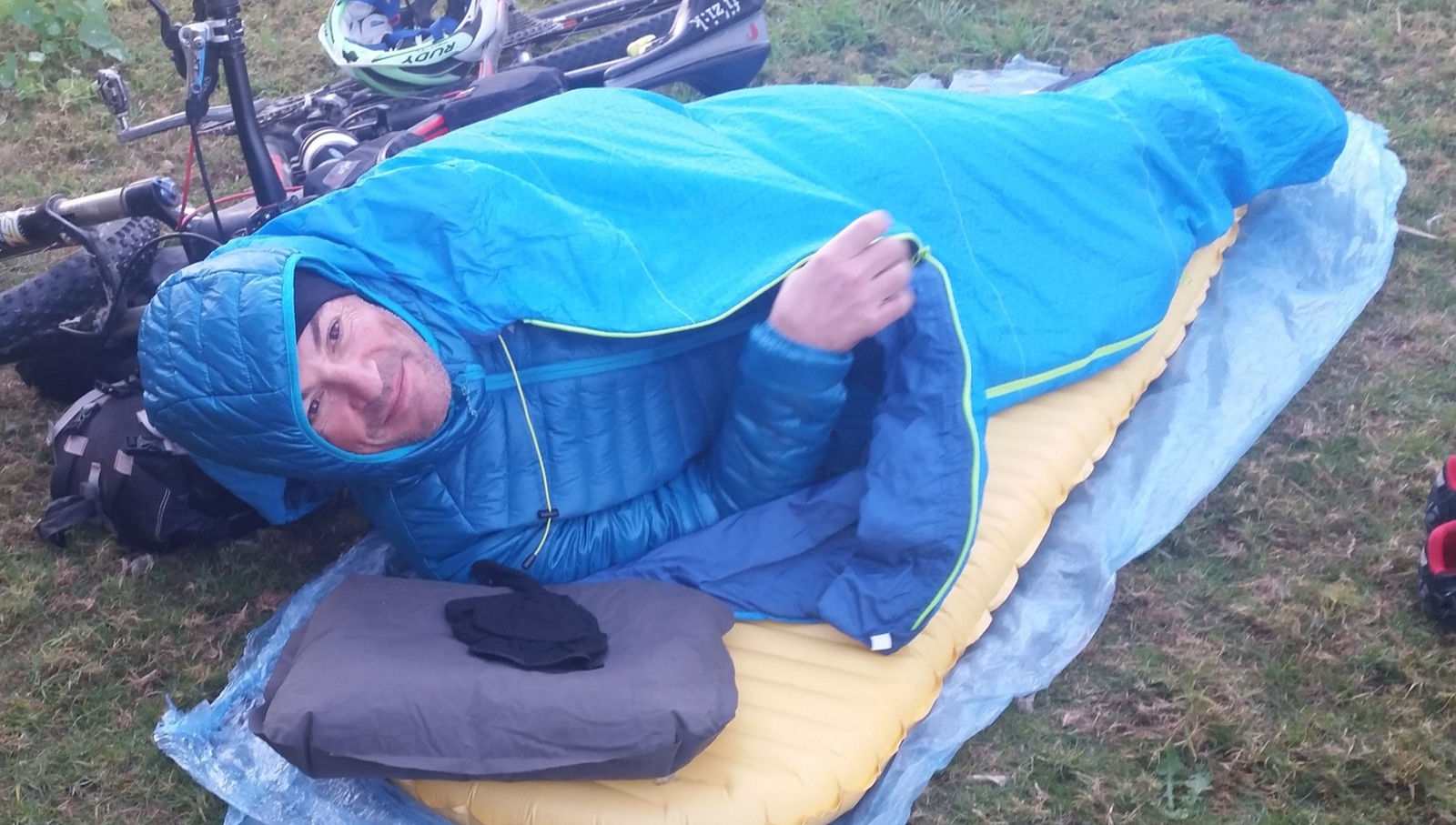
A good sleeping bag is the difference between a night you look forward to and a night spent counting the hours to sunrise. In Israel it has to handle warm summer nights, heavy desert dew and freezing winter nights in the Negev and the Golan, and still fit in a handlebar bag. Everything you need is here: temperature ratings, how cold nights really get in each region, down vs. synthetic, bag vs. quilt, weight and packed size, packing it on the bike, and care.
In short: what to check before you buy
- 01 Temperature rating: choose for the coldest night you plan to sleep out, not the average one.
- 02 Down is warmer, lighter and packs smaller, and it always costs more. For most of the year in Israel a synthetic bag is enough.
- 03 Weight: up to 1.2 kg. A good down bag for spring and autumn weighs 600–900 g.
- 04 Packed size: a bag that packs to 8–10 litres sits comfortably in a handlebar bag. One that needs 15 litres forces you to choose between it and the rest of your kit.
- 05 The bag only works with an insulated pad. A warm bag on a thin pad is still cold from below. Sleeping pad guide →
- 06 Bought a bag? Take it out of its stuff sack and store it loose until you use it.
How to read a temperature rating
Bags tested to the international ISO 23537 standard (formerly EN 13537) carry three numbers. They are measured on a heated manikin wearing one base layer, on an insulated pad and out of the wind, so in kinder conditions than you usually get outside.
- 01 Feel the cold easily? Go by Comfort. Sleep warm? Limit will do.
- 02 After a long day on the bike, tired and hungry, most people sleep colder than at home. Add a 3–5°C safety margin.
- 03 A single number without the standard's name is usually the maker's own estimate. Compare only bags tested to ISO 23537 or EN 13537.
- 04 A Fahrenheit rating (e.g. 30°F) is usually a Limit rating. 30°F is about −1°C.
How cold do nights get in Israel?
The average January low and the coldest night on record, from the Israel Meteorological Service. The stations are in towns: in open country, in wadis and on crater floors it gets several degrees colder, because cold air drains downhill and pools in low spots.
- 01 Even Eilat, the warmest city in the country, has recorded 1°C at night. “Desert” does not mean “warm at night”.
- 02 In the Negev highlands the gap between midday and night can reach 15–20°C. A warm day does not promise a warm night.
- 03 Before every trip check the forecast for the camp itself, not the nearest town, and add a few degrees of margin for a wadi or crater.
Which bag for which season in Israel?
- 01 Summer: nights are warm across most of the country. A silk liner or light quilt is enough, and even the desert rarely drops below 15°C.
- 02 Spring and autumn: look for a bag with a Limit around 5°C. Valleys and craters get colder at night than midday suggests.
- 03 Winter in the Negev, the Jerusalem hills, the Upper Galilee and the Golan: it can drop to zero and below. Here a down bag with a Limit of 0 to −5°C is worth every shekel.
- 04 Mind the wind: camping on an exposed ridge will be several degrees colder than a sheltered wadi.
How much it weighs and how much room it takes
Typical ranges for bags tested to the standard. Every model differs, so check the spec of the bag itself.
Summer: Limit of 10°C and up
Synthetic: 600–900 g, 5–7 litres packed. Down: 350–550 g, 3–5 litres. On very warm nights a liner or a light blanket is enough.
Spring and autumn: Limit of 3–5°C
Synthetic: 1.1–1.5 kg, 9–13 litres. Down: 600–900 g, 5–8 litres. This is the bag for most trips in Israel.
Winter: Limit of 0 to −5°C
Synthetic: 1.6–2.2 kg and 15–20 litres, very hard to pack on a bike. Down: 850–1,200 g, 7–11 litres. This is where down earns its price.
Sleeping bag styles
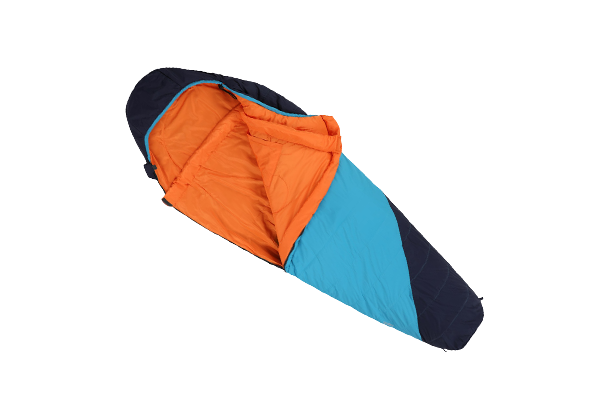
Synthetic bag
Cheap and heavier, but ideal for 2–3 day rides in mild weather. Easy to clean, and a great bag if you don't want to spend much.
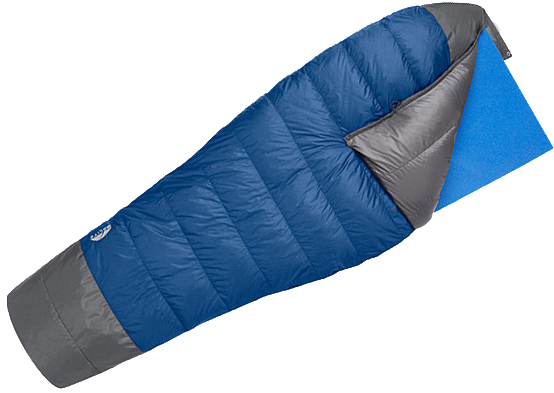
Down bag
Lighter and warmer than synthetic, and if you look after it, you'll pass it down to your grandkids. Packs very small: one of the best ways to cut weight.
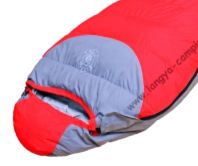
Mummy bag
Usually warmer than a regular bag, which becomes a minus on warm nights. Fully seals the head, lighter but snug inside. Less recommended for first rides.
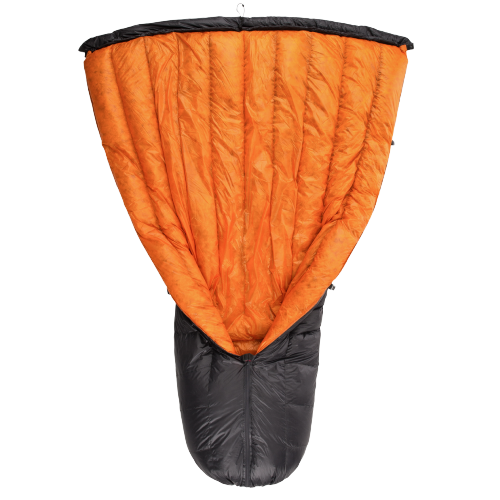
Quilt
Somewhere between a sleeping bag and a duvet. Lighter thanks to less material and no zipper, and a quality quilt usually costs less than a quality bag.
Sleeping bag or quilt?
A quilt is a bag with no back and no hood: below you there is only the pad, and the quilt straps to it. The down in the back of a normal bag is crushed under your body and does little, so a quilt leaves it out.
Quilt
Lighter and smaller than a bag with the same rating, and comfortable for side sleepers and people who toss and turn. Less good in wind and hard cold, because cold air gets in at the sides. Great for most of the year in Israel.
Sleeping bag
Wraps your whole body including your head, with no gaps for the wind. Warmer on cold winter nights and more forgiving of rough handling. A little heavier and bulkier.
The combination
A light bag for summer and spring, and in winter sleep in it with a down jacket, a hat and warm socks. That way one bag covers almost the whole year.
Down: what do the numbers mean?
- 01 Fill power (e.g. 650, 800, 900) measures how much space the down fills. The higher it is, the less down you need for the same warmth, so the bag is lighter and packs smaller.
- 02 Down-to-feather ratio (e.g. 90/10): more down and fewer feathers means a warmer, lighter bag.
- 03 Hydrophobic down keeps its warmth better in humidity and morning dew, a big plus when sleeping outside.
- 04 Look for RDS or a similar standard, which ensures the down was responsibly sourced.
Dew, damp and condensation
Dew is the enemy of a down bag. The Negev highlands get dew on 180–250 nights a year, according to studies at Avdat and Sde Boker, and mornings are wet on the coastal plain and in the valleys too.
- 01 Wet down loses its loft, and its warmth with it. Sleeping out without a tent? A bivy cover or a tarp overhead keeps the bag dry. Tent, bivy or tarp →
- 02 A bag with a water-repellent (DWR) shell and hydrophobic down copes much better on a wet night.
- 03 Don’t sleep right next to a stream or on a wadi floor. That is where the damp and the cold are worst.
- 04 Don’t breathe into the bag. The moisture from your breath stays in the down. Keep your mouth and nose outside.
- 05 At the lunch stop, spread the bag in the sun for half an hour. It dries out and gets its loft back before the next night.
Packing a sleeping bag on the bike
- 01 Its natural home is the handlebar bag: the bag is light and bulky, which is exactly what belongs up front. Bag types →
- 02 Pack it in a dry bag, even if the bike bag is “waterproof”. One shower or one stream crossing is enough.
- 03 Skip the strap compression sack: stuff it by hand into the dry bag so it fills every gap. That way it takes the shape of the bike bag and doesn’t rub the cables.
- 04 Check there are at least two fingers of space between the bag and the tyre, with the suspension fork fully compressed.
- 05 When you reach camp, take the bag out first and shake it. By the time you’ve eaten, it will be back to full loft.
Size, shape and zip
- 01 Length: the bag should be 10–15 cm longer than you. A short bag squashes the down at your feet and head and makes cold spots.
- 02 Width: a bag that’s too wide leaves air your body has to heat. Too narrow and it squeezes. Try it in the shop, in the clothes you’ll sleep in.
- 03 A full-length zip lets you open the bag like a blanket on warm nights, and a good bag has a down baffle behind it that blocks the cold.
- 04 A draft collar and a drawcord on the hood make a big difference on a cold night.
How to sleep warmer
- 01 Your pad matters as much as your bag: the cold comes from the ground. In winter, look for a pad with an R-value of 3 or more.
- 02 Don't get into your bag in sweaty riding clothes. Change into a dry layer, socks and a hat.
- 03 Eat something warm and fatty before bed. Your body makes heat while it digests.
- 04 A bottle of hot water (tightly closed!) inside the bag is a little heater for the whole night.
- 05 A silk liner adds a few degrees and keeps the bag clean over time.
- 06 Cinch the hood around your face. A lot of heat escapes through your head.
Storage and care
- 01 At home, store it loose: in a big cotton sack or hanging in a cupboard. Months of compression ruin the down.
- 02 After every trip, open it and dry it completely before storing, even if it looks dry.
- 03 A silk or cotton liner keeps the bag clean, so it only needs washing every year or two.
- 04 Small hole? Stick on an adhesive nylon patch right away, before the down starts escaping.
How to wash a down sleeping bag
At your own risk.
- 01 Fill half a bathtub with lukewarm water.
- 02 Add laundry detergent, about one capful.
- 03 Soak the bag for about half an hour, making sure it's fully submerged.
- 04 Rinse and squeeze gently, without force, so the down stays intact.
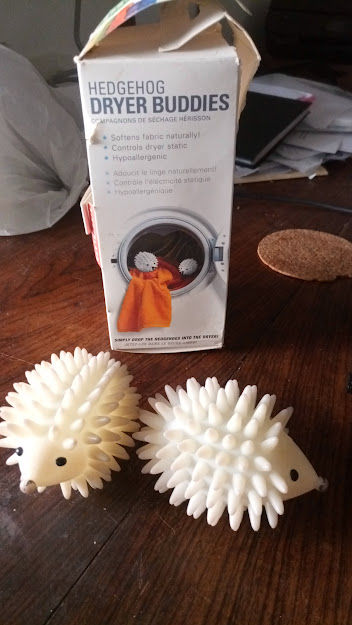
- 05 Tumble dry with two dryer balls (or tennis balls) to help separate the down.
- 06 When the down no longer clumps, you're done. Time to prep for the next trip.