Which bike
The most important message: start with the bike you have. Almost any mountain bike in good working order can handle a two-day trip. Only after a few trips will you know what's really missing, and then any decision about a new bike is much better informed.
Hardtail MTB
These are the most common bikes among bikepackers, and not by chance. Fewer parts can break, maintenance is simple, and they're easy to fix on the trail. The open frame triangle leaves plenty of room for a frame bag, and there's no rear shock to limit the saddle bag. The downside: on long rocky trails you feel every stone, especially on day two and three.
Full-suspension MTB
More comfortable on rocky, technical trails, better grip on descents, and less tiring on a long day. On the other hand, the rear shock takes up part of the triangle, so there's less room for a frame bag, and some frames only fit a small one. The shock also limits the saddle bag, because the wheel moves up toward the saddle when the shock compresses. That doesn't rule it out: many riders do long trips on full suspension, they just plan their bags around it.
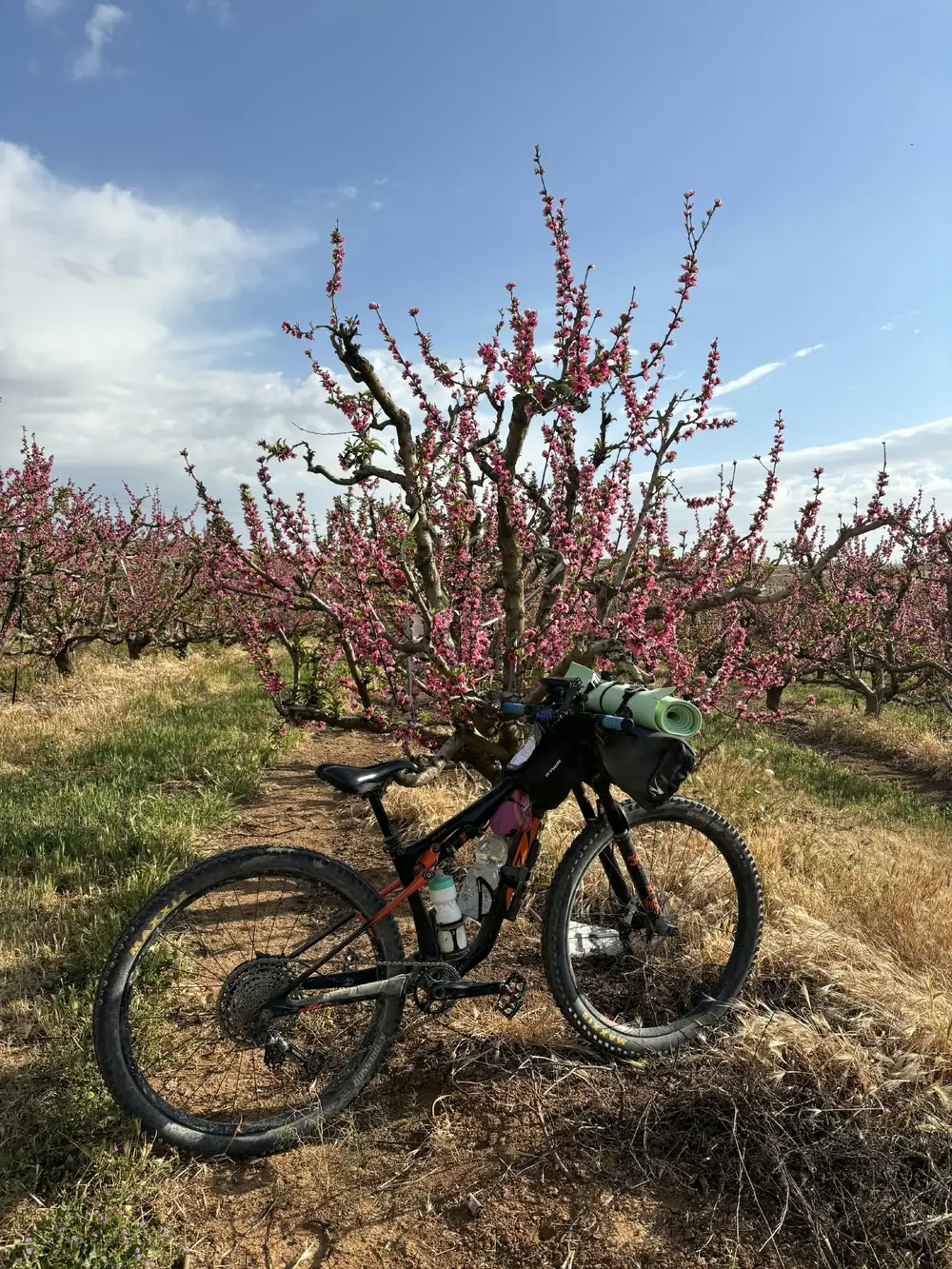
Full suspension in a small frame (S): how to pack it
On a small frame with a rear shock there’s almost no room inside the triangle, and under the saddle only a few centimetres are left before the wheel. You can still have a great trip, you just need to move most of the gear to the front and pack compact.
- The handlebar is your main storage – A roll bag or a dry bag in a harness, for the sleeping bag and clothes. A foam pad straps on top.
- Top tube and a pouch by the bars – For snacks, phone and power bank, within reach.
- The triangle – There’s usually no room for a frame bag. Keep it for bottles, and add more bottles on the fork or under the down tube with mounts and straps.
- A small saddle bag, or none – If there’s room, a small bag (up to about 8 litres) that also works with a dropper post. To check: sit on the bike with the bag full, bounce on the saddle a few times, and check the tyre doesn’t touch the bag. No room? A hip pack or a small backpack.
- Set up the suspension for the load – Add air to the rear shock and the fork to make up for the weight of the gear, and check the sag again. Do a loaded test ride before the trip.
- Small, light gear – Start with a compact sleeping bag and pad, and think twice about every item.
Gravel bike
Fast and efficient on dirt roads, quiet back roads and long flat sections. You can cover a lot of distance in a day without working too hard. On rocky singletrack and steep descents they're less comfortable and call for more care, because the tires are narrower and there's no suspension. They're a particularly good fit for routes marked as gravel on the site.
So what works in Israel?
Many routes here include rocky trails, singletrack and stony descents, especially in the Galilee, the Jerusalem hills and the desert. That's why mountain bikes are the most common choice. If you have a gravel bike, start with routes that have more dirt roads, and check the route description for how many technical sections it includes.
Tires
Tire width matters more than almost anything else on the bike for comfort and grip. A wider tire absorbs more shock, gives more control on rough ground, and is less likely to slide on gravel or rocks.
Tubeless
Israel has a lot of thorns, especially in late spring and summer, and small punctures are only a matter of time. In a tubeless tire, the sealant closes most small holes on its own, and sometimes you won't even notice there was a puncture. Sealant dries out over time, so refresh it before the trip. Even with tubeless, carry a spare tube and a repair kit in case of a big hole.
Pressure
A loaded bike puts more weight on the wheels, and pressure that's too low can make the tire fold in corners or hit the rim on a rock. So run slightly higher pressure than on a day ride, to protect the rims and avoid pinch flats. Do a loaded test ride and check how the pressure feels, not just what's printed on the tire.
Wear
Check your tires before you go: tread depth, cuts in the sidewalls and signs of wear. A worn tire slips more, cuts more easily and holds sealant less well. A tire that tears in the middle of the desert, far from a bike shop, can end the trip. If the tire is near the end of its life, replace it before you go and do at least one ride on the new one.
Handlebars
The bar decides how you hold the bike for long hours every day, how your hands and shoulders feel, and how much room there is for the front bag.
Flat bar (MTB)
Gives good control on technical terrain, descents and tight turns. It's wide, so there's lots of room for a big handlebar bag. The downside is a single hand position, and on long days your hands and shoulders can get tired. Ergonomic grips or small bar ends can help.
Drop bar (gravel)
Offers several hand positions: on the tops, on the hoods and in the drops. Changing position now and then helps your hands and back a lot on long days. The space between the drops is narrower, so check the handlebar bag fits between them and doesn't press on your hands when you ride in the drops.
Alternative bars
Swept-back bars allow a more upright position that's easier on the wrists, and multi-position bars give several different grips. Both give more hand positions and more room for bags, which is why they're popular with bikepackers. Try one before you buy, because it changes how the steering feels.
Before you strap it on
Make sure the handlebar bag doesn't pinch cables or block the brake and shift levers. Turn the bars fully to both sides and check the bag doesn't catch on the frame and the cables aren't stretched. A heavy bag on the bars affects steering, so keep it mostly for light, bulky gear like the sleeping bag and clothes.
Gearing
A loaded bike is much heavier on climbs. Gearing that works fine on a day ride can feel very hard once you add ten or fifteen kilos of gear and water.
Why it matters so much
On a multi-day trip, the question isn't only whether you can get up the climb, but how much energy you'll have left for tomorrow. An easy gear lets you climb at a comfortable pace, without burning your legs or getting off to push. It also takes load off your knees.
Climbs too hard?
A smaller front chainring is a cheap and effective change, and usually doesn't require other new parts. Another option is a cassette with a bigger rear sprocket, but that sometimes also needs a matching derailleur and chain. Ask your bike shop what works on your bike.
Suspension and clearance
Bags and suspension have to live together. A few simple checks at home save rubbing, worn tires and damaged gear on the trail.
More on setups and clearance →Rear shock
When the rear shock compresses, the wheel moves up toward the saddle and can hit the bottom of the saddle bag. Sit on the bike with the bag full, bounce on the saddle a few times, and check there's a gap between the bag and the tire. If there isn't enough room, move heavy items to other bags or choose a smaller saddle bag.
Dropper post
A dropper post takes up part of the seatpost the saddle bag straps to, so there's less room for the bag. And when the post drops, the bag can hit the wheel. There are bags and mounts designed for dropper posts, but they're usually smaller.
Suspension fork
When the fork compresses, the front tire moves toward the bars and the front bag. Check the handlebar bag doesn't hit the tire: push down hard on the bars and look at the gap. A bag that touches the tire can wear through very quickly, and can even brake the wheel on a descent.
Mounts
In the desert, every extra litre of water counts. The more places you have for bottles, the further you can ride between water points.
Bottle cages
Look for bottle cage mounts (threaded bosses) on the frame and fork. Many frames also have mounts under the down tube, and some forks take large cargo cages. They let you carry more water, which is critical in the desert, where you sometimes ride tens of kilometres without a water source.
Frame bag in the way?
A full frame bag sometimes takes the space where the bottles go inside the triangle. You can choose a half-frame bag and leave room for a bottle, or move the bottles to the fork and down tube.
No mounts?
There are adapters and straps that attach to the frame or fork and hold a bottle cage, and they work well. Make sure they're tight and don't rub the paint, and check them again after the first sections of the ride.
Comfort
Three days on the bike magnify every small discomfort. What feels fine on a two-hour ride can turn into a real problem on day two.
Saddle
Ride a saddle you already know works for you. Never try a new saddle for the first time on a multi-day trip. Good padded shorts also make a big difference, and it's worth testing them on long rides before the trip.
Hands
On long days your hands absorb a lot of vibration, and your fingers can go numb. Padded gloves and thick or ergonomic grips help a lot. Changing hand position now and then while riding also eases it.
Fit
If something hurts on a normal ride, like your knees, lower back or neck, it will hurt much more after three days. Sometimes a small change in saddle height or position is enough. A basic bike fit at a shop is worth it, especially before your first long trip.
Checklist before the trip
Go through it a few days before the trip, so there’s time to fix things. Your ticks are saved in the browser.
What’s next?
How to load the bags, what to pack, and who to ask when you’re not sure.